01
Measure
We establish a shared, indisputable performance measurement before taking any action.
- OEE / OOE performance measurement (NF 60-182)
- Shop-floor readings and production data reliability
- Mapping of losses, bottlenecks and WIP
Together with your teams, we lead the initiatives that genuinely move your indicators: performance measurement, problem solving, line design, automation and system integration.
Explore the method ↓An initiative starts at the gemba, where value is created: we observe the workstation, measure, listen to operators and trace problems back to their causes. Our role is to bring method, pace and an outside perspective — then to leave with your teams able to do it again without us.
Everything starts with an indisputable measurement. We calculate OEE and OOE according to the NF E60-182 standard, making each family of losses explicit: stoppages, slowdowns, poor quality. A performance measure whose definition is not agreed upon will never produce an action plan that is.
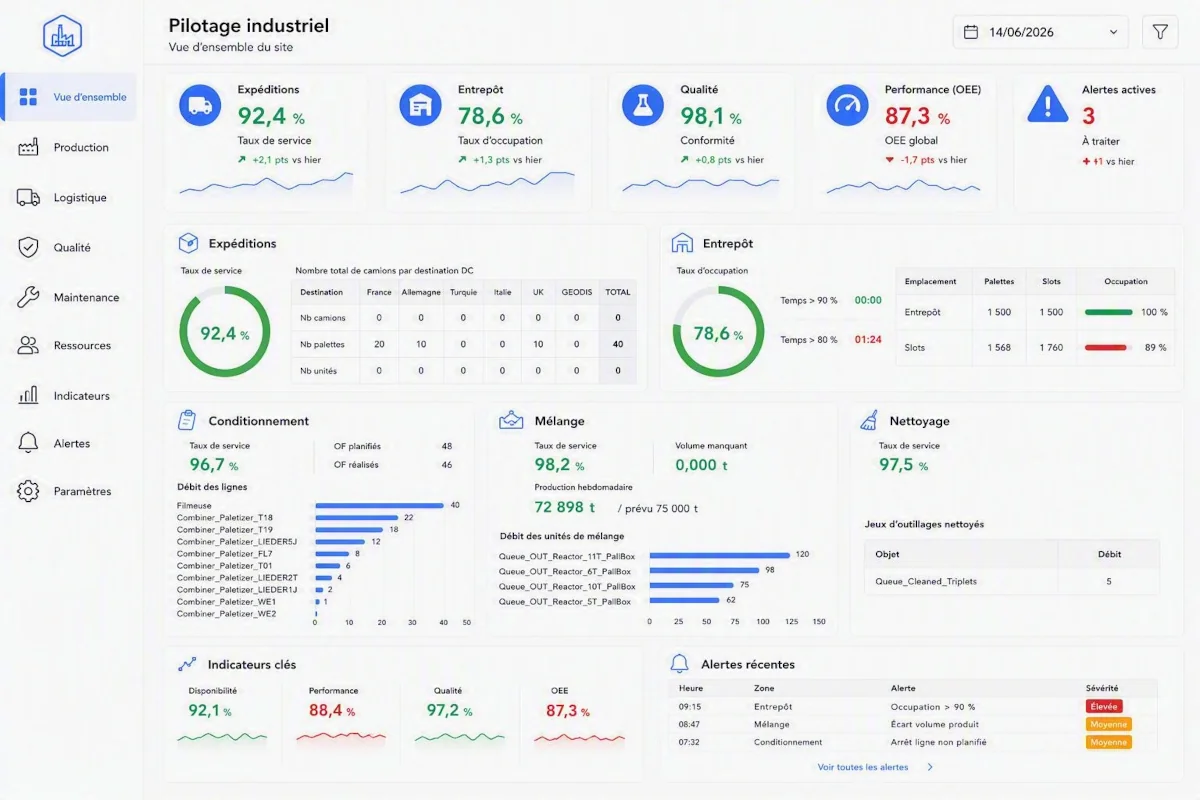
The digital side is not an add-on; it is what makes the gains last: automated readings instead of manual re-entry, reliable and structured production data, integration between the shop floor and your systems, and indicators that make sense to those who make day-to-day decisions.
Our foundation remains the Toyota Production System described by Taiichi Ohno: just-in-time, pull flow, eliminating waste — with the development of human capital as a condition for results, not a consequence.
We establish a shared, indisputable performance measurement before taking any action.
We tackle root causes with the teams concerned, not the visible symptoms.
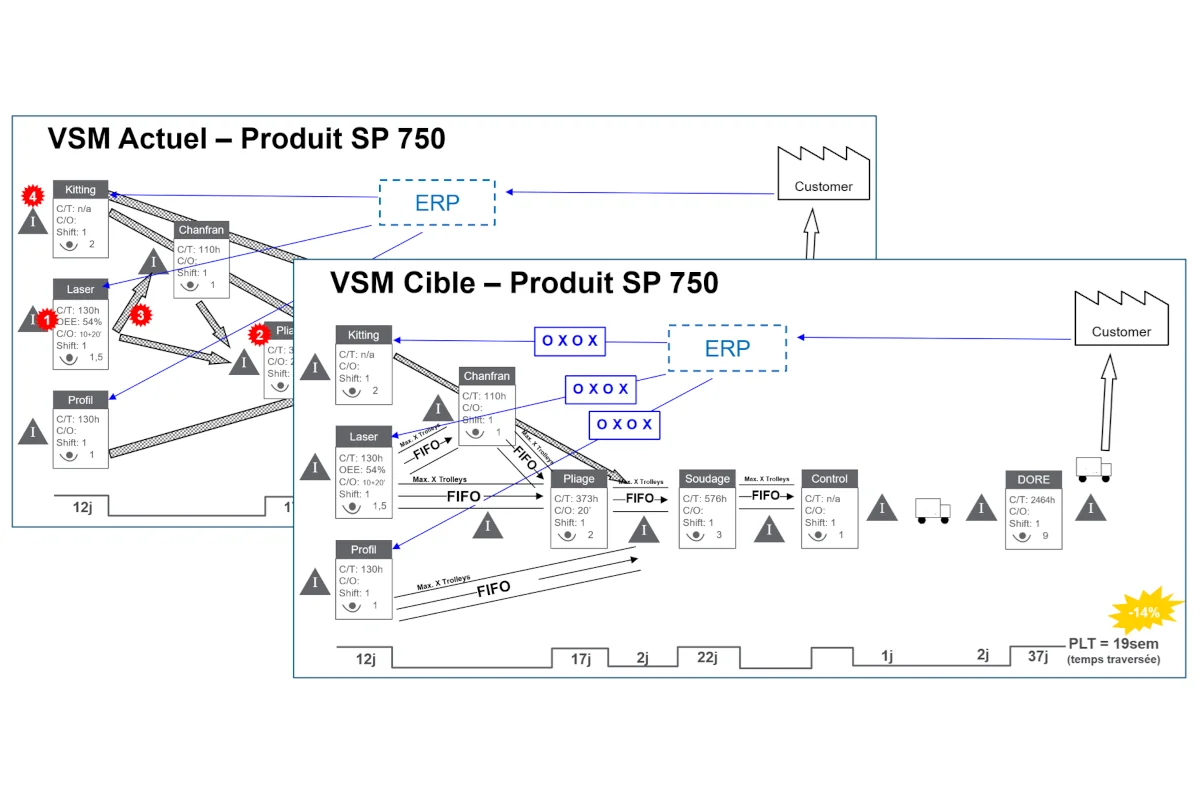
We re-lay out, pace and connect the line so that product and information flow.
We put in place the management rhythm that prevents backsliding.
OEE / OOE calculated within a standardised framework: losses are named and quantified before any action is taken.
Our initiatives are run at the workstation, with the people who do the work. Countermeasures come from the shop floor and go straight back to it.
Automation is only useful if it eliminates re-entry, makes data reliable or shortens a decision loop.
Our working references are public and can be shared with your teams: Taiichi Ohno's Toyota Production System for the fundamentals of just-in-time and waste elimination, the Schneider Electric Performance System, the work of the Institut Lean France on what makes a lean system hold — or collapse — over time, and exchanges with peers on industrial performance.
To this foundation we add our experience of industrial performance systems deployed in large groups and our command of production data — the part often missing from traditional lean approaches.
Let's talk about your context →