Builds the model
From Excel files, ERP extracts or a description, and flags missing data. Shortens modelling time.
We model your lines, flows and assets to simulate, test and de-risk your industrial decisions before committing the shop floor.
Explore the method ↓Before moving a line, changing a layout or investing in new equipment, you need to see. We build an accurate digital representation of your workshops, flows and assets. We can use your historical data. Where needed, we can connect to real-time data.
We favour mathematics over aesthetics.
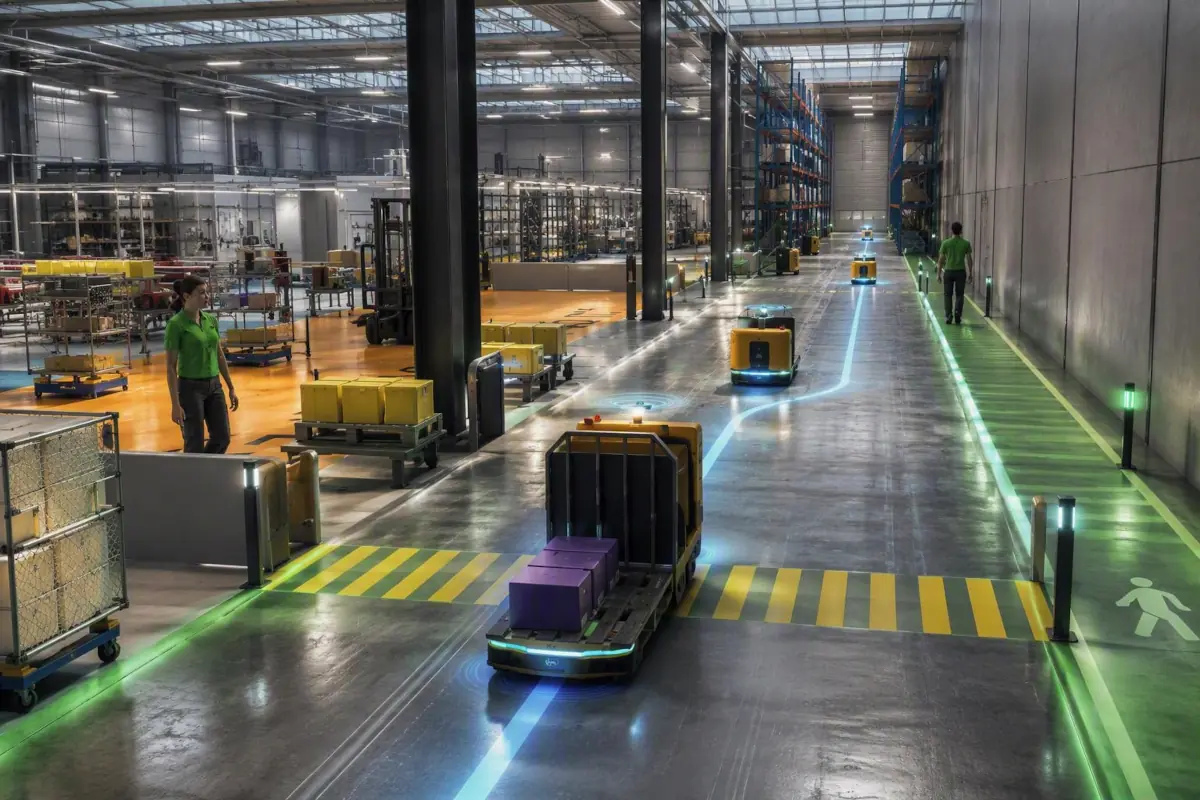
This digital twin becomes a decision-making tool: simulate production planning scenarios, test a reorganisation, check that load matches capacity, identify bottlenecks, optimise floor space and intralogistics flows, size an AGV fleet — without interrupting actual operations. 3D provides an indisputable medium that incorporates all operational constraints. Its power to communicate builds buy-in.
We equip you with a decision-making tool to validate the sizing assumptions for a new line or plant and secure your investments.
From Excel files, ERP extracts or a description, and flags missing data. Shortens modelling time.
It generates and simulates dozens of them, then keeps only the significant differences. You see the real levers, not just the 3 scenarios you would have thought to test.
Breakdown, absence or shortage: countermeasures simulated and ranked in minutes. Decision support for the next shift, not just for the annual plan.
In lean language, tailored to each audience (plant manager, industrial engineering, team leader). Results are understood and used without a simulation expert.
It compares simulation with reality and proposes recalibration. A persistent gap reveals a real change on the shop floor.
Once validated, it creates an action in the shop-floor tool or alerts a manager. The decision becomes part of the workshop's daily routine.
We clarify what the simulation is for: which business outcomes are expected, measured by which indicators (KPIs), and which source data is needed.
We map the manufacturing flows and processes within the agreed scope.
We build the model from the site's production data.
We check the model's results against a test situation and the KPIs defined upfront.
We connect the model to data sources and add advanced features.
We train your teams to use digital tools day to day to address concrete use cases.
A client with no downtime history (low level of documentation) cannot benefit from recalibration. The agent's value depends on the level of data available.
A simulation result must always state its assumptions, number of replications and confidence intervals. Otherwise the agent gives a false impression of certainty.